Eka Zharinova — 13/12/2025
The performance bulabulay mun? / how are you? questions dance standards
I attended the performance bulabulay mun? / how are you? by Taiwanese dance theatre Tjimur on October 21. It followed by a post-show talk with the company’s artistic director Ljuzem Madiljin and choreographer Baru Madiljin (translated by the project’s producer Jih-Wen Yeh and BSL interpreted), hosted by Eddie Nixon, artistic director of The Place. The performance was a part of Dance Umbrella Festival this year.
That day, I came to The Place only knowing that I will see a dance company from Taiwan which is on tour in Europe and the UK right now. I also wanted to catch up on Dance Umbrella Festival’s programme since I could not make to see any other performance this year.
I was looking for a paper programme, yet what I found was very limited in terms of information. And I decided that the art piece should speak for itself without a description or explanation. Thus, I alerted all my ways of experiencing performance works, which I can be aware of, and anticipated what would happen in the moment.
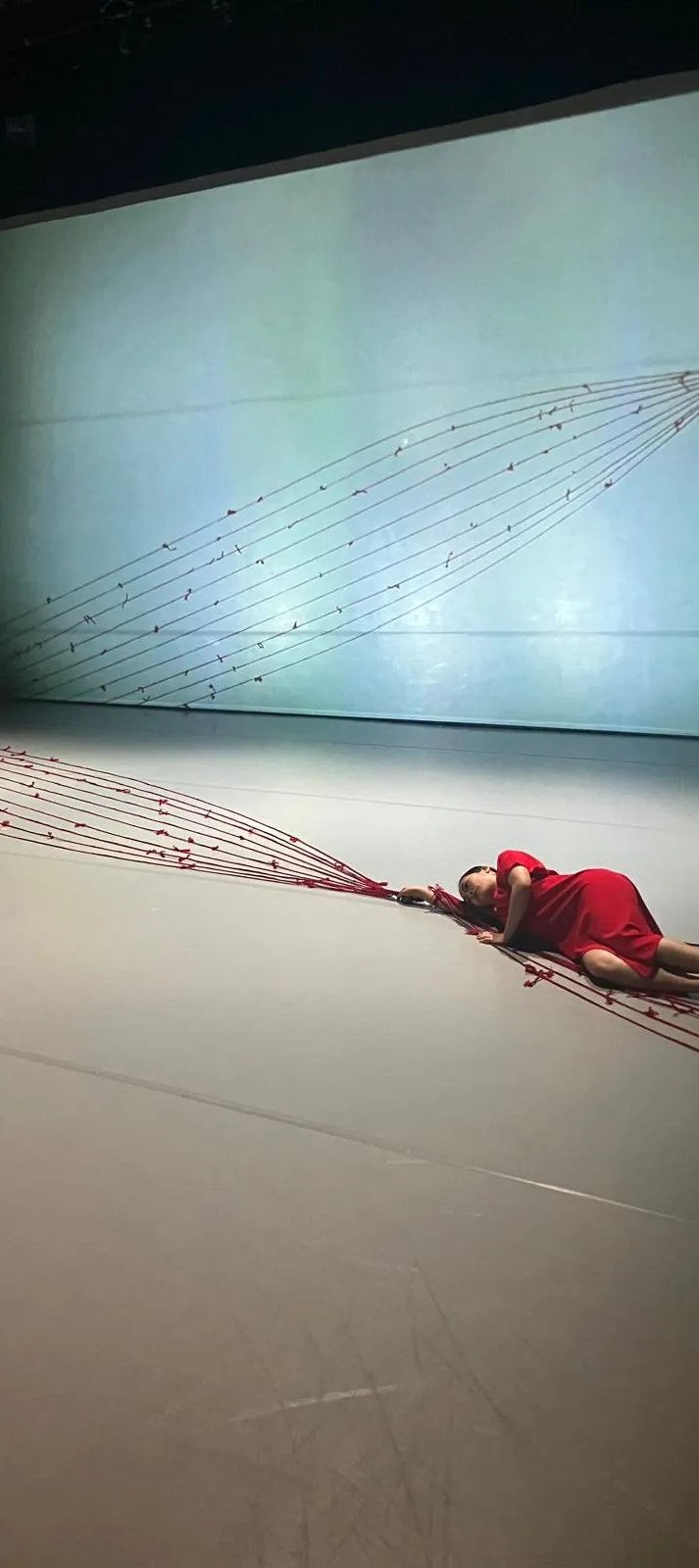
Curtains were opened from the very beginning and while audience members were finding their seats, the female dancer in a red dress was lying on the white dance floor and grabbing with her hand a bunch of red endless strings which continued beyond both sides of the stage. On the big white screen (almost the same big as the stage) behind the dancer, we could see a live broadcast of the stage viewed from the ceiling.
It looked like the woman was washed ashore by the ocean. Ocean can threaten, and it can mesmerise. Any ocean is connected to every other ocean and eventually to all the seas and rivers. There is a global unity via the water movement, which links the whole world.
The woman remained still lying on the floor until the audience found their seats, ready to enjoy the show. Then, she was very slowly dragged behind the curtain upstage right. The prelude was appealing to me. Yet, I cannot say I liked or enjoyed watching the performance itself. I had complex feelings about it. I could not appreciate what I saw because it was not aligned with the dance standards I am used to. It did not resonate aesthetically, kinaesthetically, nor in what they did body-wise. And I decided to write about this performance because it represented something drastically different in the field of contemporary dance, which I belong to and am following in the London area.
Everything looked unusual to me compared to what I had seen at The Place and other major dance venues in London in recent years and previously in other places. The performance’s dance language/vocabulary looked simple, not virtuosic. Yet, they did some extraordinary, or not easy to implement, things like stepping on each other’s backs. It was impressive when a male dancer stepped on the back of a female one; I am unsure I could provide a solid base for that kind of step or make such a step without losing my balance.
They did not focus on showing a dance technique; their intention was to represent their people and culture. Yet, the technique was there, a very particular one. The movement was performed with great attention to detail, just the movement looked different.
I believe movement in contemporary dance should be diverse, yet I got accustomed to seeing a similar type of movement in this context. And now, when I was presented with a different type of movement, I was questioning whether it was contemporary dance. What makes it contemporary dance? What is contemporary dance?
What I like in contemporary dance, which I know, is the spine moving freely in all its sections and directions, using its affordances as much as possible. The spine is usually more flexible and mobile in contemporary dance compared to other forms of dance. Here, in bulabulay mun?, the spine was very specific in shape and movement. It was elongated, perfectly vertical, and never bent, just in its wholeness (slightly) leaned forward at times. Thus, the spine movement was limited in this performance.
And the foot movement looked restricted too, while I learned, when I was a teenager, from several dance teachers that feet in dance need to be equally well articulated as hands (as a target, not really achievable, of course). In bulabulay mun?, feet are not for decoration purposes, but to stand on steadily, provide a decent support (especially when someone is standing on your back), and confidently move through overcoming obstacles (created by other bodies, or imaginary ones, as the dancers moved like going against a strong wind in a section closer to the end).
I had a few more confusions. First, I personally enjoy, when there is a play with a weight centre, losing and catching it in dance. Here, the dancers carried their weight across the space practically never losing yet, rather exhibiting extraordinary sense of balance.
Second, in my experience, having a unified breath and emanating a sense of unity while moving as a group is a valuable skill that can be achieved over many years of dancing together. The company’s members have danced together for two decades. Yet the dancers moved as if they were separate self-sufficient beings, valuable on their own, and just needed to execute something collectively to survive, and they fulfill their roles responsibly.
Third, more dynamic dance parts reminded me of martial arts (not dance), like Aikido.
The choreographer Baru Madiljin said that he wanted his dancers and choreography to be different. He aimed to represent the Paiwan people and intentionally referenced their traditional dances, literally using some steps from their tribe’s dances/rituals, which the dancers regularly practice within their community.
bulabulay mun? included a video of the ocean or a sea, a big dry tree branch as you might find on a seashore, red strings, and a red fabric as a long carpet to walk on, and flowy loose costumes - all of these framed the dance. All five dancers were singing as well as dancing, yet movement was the core, and in particular movement generated and practiced by the Paiwan community over thousands of years.
It was crucial that it was presented on stage. They inscribed it into the nonverbal dance discourse.
bulabulay mun? speaks for the importance of standin
The widely acclaimed contemporary dance company, Tjimur, is based in southern Taiwan and is dedicated specifically to representing Paiwan culture and identity through movement, which incorporates indigenous folk songs from the Paiwan community.