12 January 2026
Crash Course: Confabulations, or how we construct narratives
An intimate discussion of queer archival methodologies and reflections of identity in a changing city. Part 1
Cyprus
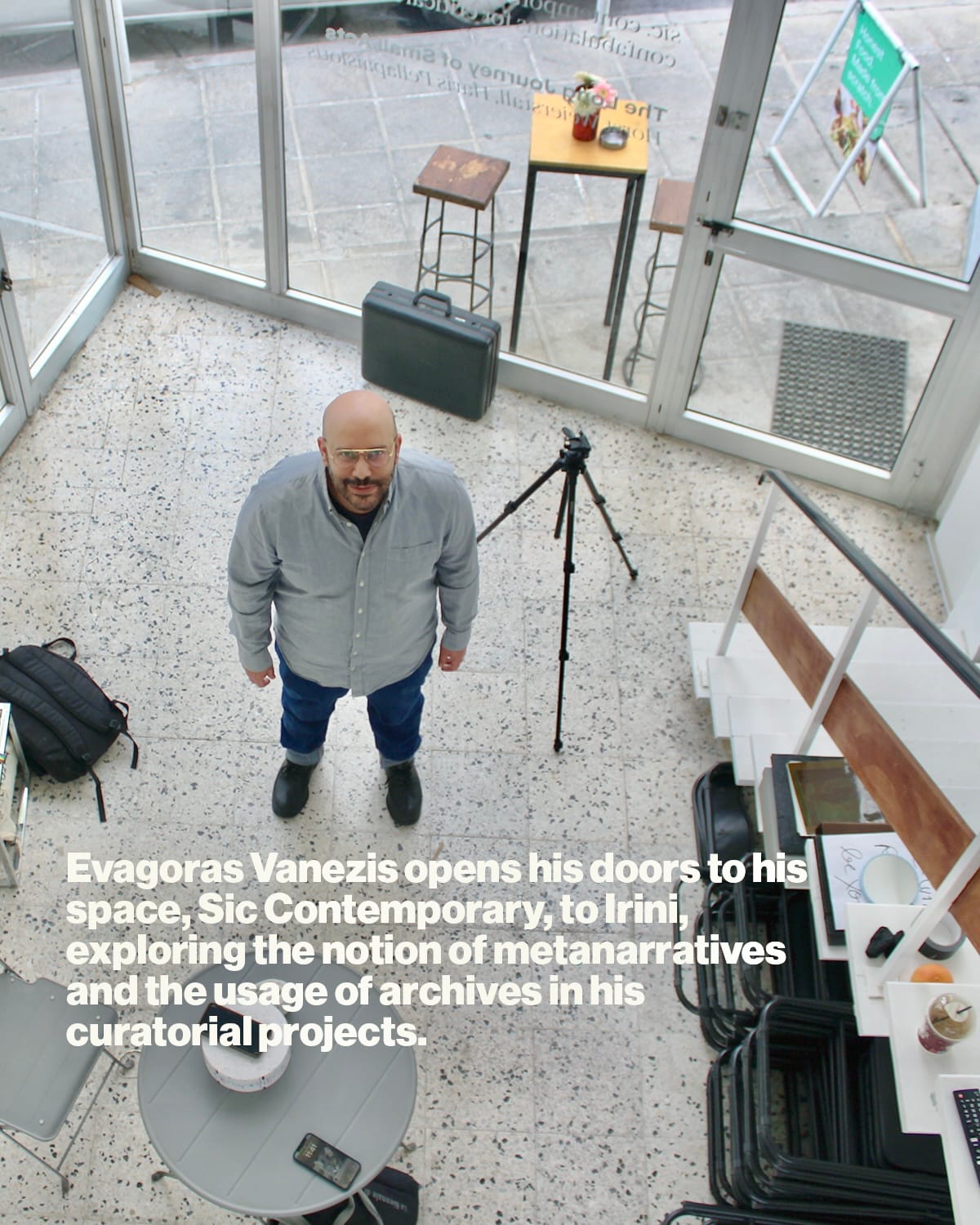
Evagoras Vanezis opens his doors to his space, Sic Contemporary, to Irini, exploring the notion of metanarratives and the usage of archives in his curatorial projects.
Irini Kattou x Evagoras Vanezis
IK: So, the space is called SIC. Yeah, tell me about that.
EV: SIC is a borrowed term from academia. And it has a long history in academic politics because it comes from Latin and it means as found in an original source.
Then academics would use it when they wanted to quote something that was patently… It had a patent mistake in it. Okay? They would anyway quote it and then they would write SIC in parentheses to indicate that it is not necessarily their own understanding of things. Okay. Or it could be simpler. It could be that it has a spelling mistake. Okay. They just would write, this is how I found it.
IK: Oh, so to avoid them to be like, why did you make this mistake? They would be like, this is how I found it. It’s not my mistake.
EV: I’m just showing you the evidence. Exactly. It has this connection to evidence. Which is interesting to think in terms of crime. So somehow it was used extensively at one point and then in the academic politics it got dropped for various reasons. Like there was a discussion in academia about whether, what does it mean? It got misused as a term. So now there are also other ways to use it.
Politicians also use it a lot. When they post on Facebook, actually, or like social media. They say to show that this is not my position. Just saying someone else. I’m reiterating a position. It’s like ironic in a way. We wanted to play with this quote. Like, what’s happening here? Is it ironic? Is it not? Is it, you know? And because we have a bit of a focus on unarchiving, so looking back. I was going to say about archiving. Especially performance histories.
And bringing, sort of reactivating or reenacting some things. Because we believe it’s, they had a certain importance when they happened. And they’re still relevant. But we need to examine how and why they’re still relevant. And to whom.
IK: Your work about Oikonomou. But even the more recent one, Meleagrou. It’s interesting because you’re using these figures.
They’re archived of sorts. But you’re making new work? Or like, how do we present it in a fresh way? Using performance as a methodology of archiving itself. And I want you to talk a little bit about that.
EV: I mean, this is a combination of, let’s say, two things. One is curation. Which focuses more on how do I tell a story in an exhibition format. And the other is an interest in how we as human beings understand these stories. Because what I take for granted, let’s say, is that subjectivity comes into a space. And they carry certain things with them.
And they are in their body. So how they will understand what they see directly links to their… Understanding. Yeah. And their condition as well as their embodiment. So that’s how I started looking into these more performative ways of exploring archives. Because I think it’s directly linked. With curation, it’s always a question of how. How do you show this? How do you show something? And it’s a bigger question of how do you construct the idea of an audience? Like, do you want a passive receiver? More mind focused? Who will read something and understand the message? Or do you want the audience to be more active? So, it’s all these ideas about active participation. And what does that mean? And to me it’s sort of like a scale.
IK: Yeah. Because I assume there are scales between what it means to be an active participatory audience. It could be very active.
EV: I guess you can have an embodiment. You can have sound. You can have them maybe actually literally interact with the objects. Or just looking. But also interacting from a distance. I mean, the predominance of looking is very hard to destabilise in a way.
Many people do it successfully. But it comes down to that you need to show things. This is also interesting in reference to what we said about reference and crime.
IK: Because it’s always this idea. That you have witnesses.
EV: Exactly. But memory, how do we use memory? So now we use a lot of the term witnessing. It’s that you produce something. You bring out something into the world. And then you expect it to be witnessed. And what this means is up for interpretation.
And it depends on what it triggers. More than what it wants to say specifically. So yeah, this is with Meleagrou. It was a bit different in that the archive that we are talking about was the artworks that she had in her home. And we were looking for a way to show all these works in a non-hierarchical manner.
IK: What hierarchical manner were you worried about?
EV: Okay, this starts usually the hierarchy. It goes through mediums. For example, you can say that painting is more important than printmaking. And so on. And value.
So, paintings are more valuable, quote unquote, than… I’m talking about what Meleagrou had in her collection. She had a lot of painting. A lot of printmaking.
Traditional art from various countries that she collected in her travel. That are sort of pigeonholed into a category of craft. This is another distinction. And she also had a lot of copies. Like things she would cut from calendars, newspapers. But she would read them in the same way. This became a very interesting viewpoint. That we wanted to follow in a way.
IK: And as she herself didn’t hierarchise. She just had it everywhere on her walls.
EV: Exactly. And sometimes the way she had things together was very surprising. It didn’t follow a clear-cut aesthetic pattern. Either with colour, medium, theme.
I view her as sort of a mad detective. Who was looking for things in images. And she was putting them together to test ideas. Because it fits also into the way she was writing. And that was the starting point. Or let’s say the evidence that we had.
And we sort of wanted people to have in a way this experience. Where you enter a space. And there really is nothing to guide you into these hierarchies. So instead of playing with the hierarchy. You play more with chance or with words basically.
Because what people did have in their disposal was the captions. So that was a caption list. And people would choose which words to see. That was the performative trick. And then people would say, okay, I want to see number 30, 100. We created sort of these storage spaces. And people would see the back of the paintings. And then they would choose numbers from this caption list.
And we had performers who were very diligently following a score. Of bringing works from the storage area into an exhibition area. And the exhibition area was also basically a set of shelves. So that things would sit on equal footing. And then each individual would see the selection of the prints or paintings.
IK: They would be the curators of their experience. Correct?
EV: Exactly. Okay. This was again the intention.
It was to have everyone who comes to the exhibition. Be a co-curator of the exhibition. With a very nuanced distinction between. Not between. Focussing on the fact that this is an exhibition. And the time of the exhibition exceeds the time of an individual visit to the exhibition. What do I mean by this? You might come and say, I want to see works. Three works. But then ten more people come at the same time.
And they all want to see the works that they choose. It doesn’t mean that it will necessarily happen. Because you have to follow the performative trajectory of the exhibition. Works could come out three hours after. People could actually come back and view them. Many did.
They would come back throughout the day.
IK: So basically, you were playing also with the concept of time.
EV: Yes. You would go but see what somebody two hours ago chose.
IK: Yes. But you were directly implementing something that the next viewers would experience also. The exhibition now was the exhibition of the past. You were playing. Oh my God. It’s very interesting. Also, sociological.
EV: Yes. Experimenting a bit. Because it’s like you’re saying to the audience, you are now the co-curators of the exhibition. And the time of the exhibition will also guide how you collaborate with all the other co-curators.
IK: Was it difficult to make people interact that way? Did you give them any guidance?
EV: I mean the experience was scripted or scored as we say in performance. They would know exactly the steps they needed to do in order to choose works.
And they would also be aware of the fact that they might not see the works they chose. What we noticed was there was some resistance by some people who were expecting to see everything. And also, then another type of resistance when they said, okay I’m doing work. I am choosing what I want to see, and you don’t bring it to me. There were some frustrations with the audience. This was also very interesting because it played upon expectations. Expectations of spectatorship. It’s very like, I ordered it so why can you not deliver it? It’s very in this capitalist logic.
So how do you sort of play with that? And we thought performance is a good way to play with that. Because they might not have seen the works they wanted to see. But what they did see is performance moving in and out of exhibition of storage areas.
And sort of doing the work of reassembling the exhibition. They would know that there is someone that is working for this. And it’s a body and it works in a specific rhythm. And you cannot force the other person to move it along or move quicker to cater to you. I don’t know, it was very interesting.
IK: So, if they brought one painting out, how long did it stay for?
EV: This again depended on a collective agreement made between the performers. Because there was always two or more. They would check in with themselves basically and with the space. And they would say, okay, we now have four works out.
We need ten more. When the requests came, they would literally just bring out ten more works. Then they would say, okay, this feels good now. It feels like an exhibition. People are interacting with the works on display. Interacting, I mean, they are seeing them.
They are sort of going back to the list to check what it is. And then they would slow the pace. It was also reading the room. Yeah, and I think it has to do with sort of allowing more of an intuitive response to what is happening between audiences, artworks, and the performers. It really was a three-way relationship in the space. And I sort of like that because it continually shifted the agency inside the exhibition. And all these different people, objects, etc., they had to work together in a way for this thing to happen. And what I find most exciting is that this process sort of, not repeated, but made visible the way Meleagrou was collecting. Because the combinations that were happening, they were random.
Or they were decisions of many various people. You would see the most expensive painting next to a very cheap print, next to a traditional Indian miniature painting. All these things sort of flowed together.
IK: And at the end of the day, they really gave you an idea of who Meleagrou was, or at least who she was as a collector. But isn’t that also projecting your own idea of what you understand for the objects? Like, I see what you mean, but you see what everybody has there. You can see what she has collected, but it’s not the way she put it in her house. And you wanted to avoid that. So, you’re also thinking that you have your own ideas of what it is, the way it is put together. There are always new meanings there.
EV: This is an excellent question. Because we thought about this a lot. And what we did, how we enacted this worry, let’s say, is that when we put the things in the storage areas, we separated them according to where they were in the room, where they were in the house.
All the things from the bedroom would be together. All the things from the living room would be together. Not that it really mattered at the end of the day, but you could sort of, if you study this, you understand more, or basically it convinced me that there really was no specific order or obvious logic behind it.
For her. For her, yeah. I mean, no, for her, she might have had her reasons. But it’s this thing you say where we cannot project. We cannot really know, because we didn’t ask. We’re just like, hi, girl. We want your stuff, they’re interesting. But also, that is an interesting choice, given her. But it’s also the question of, obviously, she has done so much about literature, and she’s such an important figure, a woman in the 50s, 60s, 70s in Cyprus. And it goes into also the question of, whose objects, who is the collector? And why is her object special enough to have an exhibition in a way? This is also another mechanism that we don’t usually think about. Artworks that are in a home, they’re sort of artworks in a home. They might constitute a private collection, or a collection that is not seen. I mean, publicly. When a decision is made for various reasons, in this case, it was because of how interesting the constellation was. If you take it to the public, and all of a sudden, it’s this named, catalogued collection.
It changes meaning. It changes meaning, and it changes a lot the new things that can happen with it. Because what we could have done, instead of what we did, it was to present a coherent narrative about the artworks. And we could have done that. It’s not that it’s the most difficult thing in the world. But it means that you make a lot of arbitrary choices on what to exclude. Because it came from a whole.
IK: Exactly. And the decision to include everything is what led to all the rest. It’s a game of inclusion and exclusion.
EV: Because Germany has such a complicated history, they are trying to understand things about the position of queer people, both in West Germany and in East Germany. Okay. Were they different? They were a lot different, and it’s not what you would expect.
Because in a way, in the sort of communist part, actually there was a lot more freedom. And they have a specific sort of narrative about the clause in their constitution that deals with whether it is legal or illegal to be gay. And this was handled differently in the communist part than in the sort of Western part. But they also had more… Women had a bit more different expectations in society. This is also very interesting because they had an exhibition now by a photographer who was a lesbian and a feminist.
She would photograph a lot of circles, a lot of people who would sort of occupy space and escort it. And then these things became established. The city sort of gave it to them, but they became established in a way that now they are affordable housing, gathering spaces.
There are some militant people who are keeping up the traditions. Or what happened. And they’re playing this institutional punk legacy of what has happened.
Our trip there was to meet the people who are running it and understand how they archive, what they archive. Continuing from a project we did last year that was called No No Bad Timing. That was sort of the first effort to institutionally frame the matter of queer archiving.
And how it was also handled in a very performative way, I would say, in that there were some invited archivists and each person could enact a method that they think is the most interesting for this. For example, we had Evita Ioannou, who produced a monologue, a theatrical monologue. We had Deomides Koufteros, who sort of brought out some of his diaries and tapes that he would have.
And some photos that he found from the 80s and 70s, where people entrusted him with this. We had to negotiate with these people what to show, what not to show. We had a lot of beginnings of a lot of things.
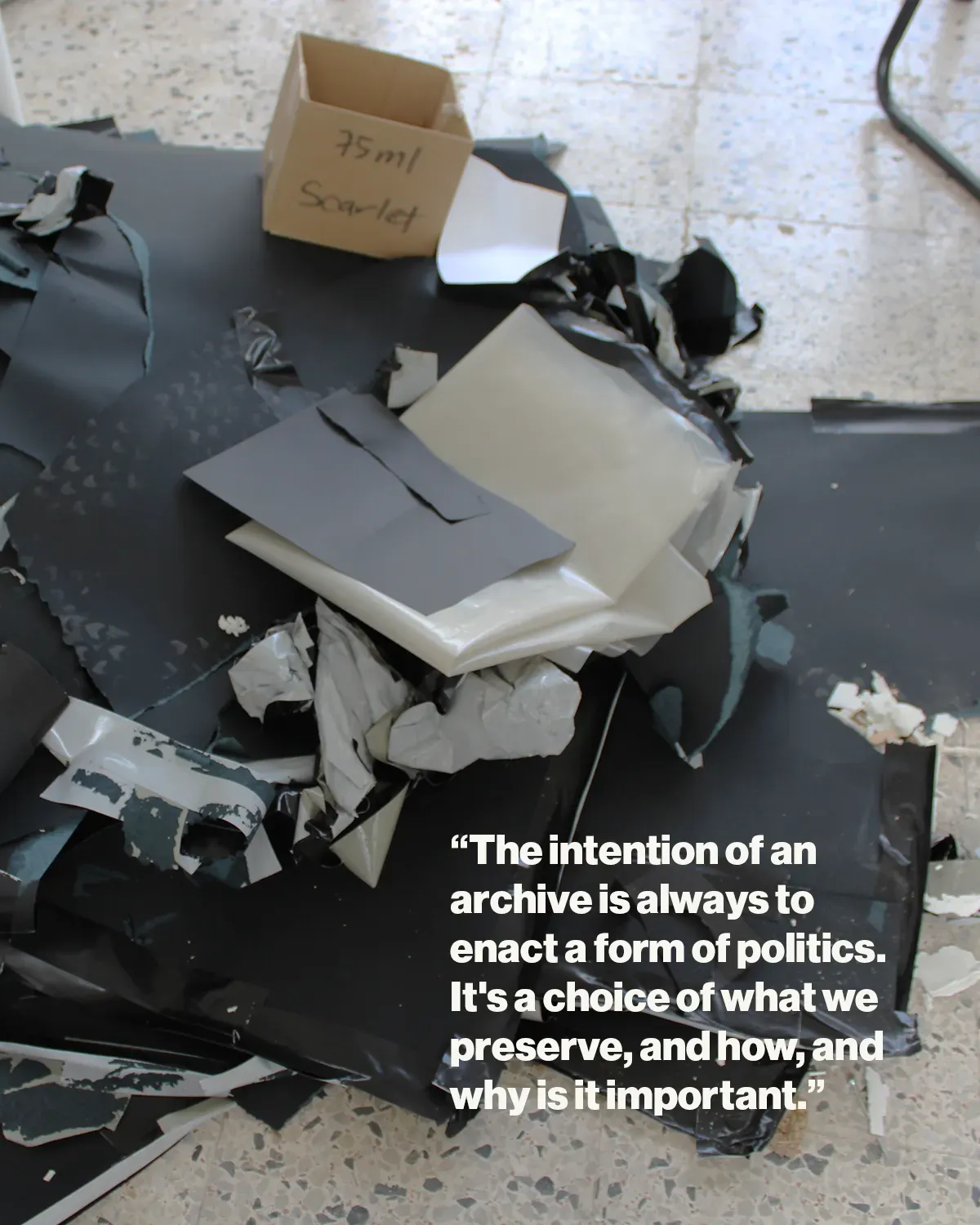
And it’s always the same question of whether you want to establish something that then becomes more official, in a way. It’s this idea of the archive, and the intention of an archive is always to enact a form of politics. It’s a choice of what we preserve, and how, and why is it important.
IK: Coming back to your space, the title, the name of your space.
EV: Yes, which is this idea of sic, and this idea of, okay, I found this, so I need to acknowledge it. And I sort of need to understand what it is, and what it did in the past, what it does now. [in relation to Cyprus].
IK: Was that like, did it come from a place of feeling uncomfortable with certain narratives? Like wanting to make new narratives, new witnessing?
EV: Yeah, I mean, I think it’s definitely a level of uncomfortableness in this. But also, an acknowledgement that we live in between these different narratives. And nothing is set, in a way. We can very easily think we are doing something else, whilst in actual fact, we are just repeating something. And it’s not about it being new or different, it’s about we sort of repeat the same traps, or the same mistakes. It’s always this question about history, in a way.
And what I find in researching, and in producing these projects, is that you can really see where they went in a way that was beneficial. Beneficial to more freedom, more rights, and they really created new spaces for people to be together, to understand each other, to reflect. And yeah, this is what is the important legacy for me, that I try to bring out, through doing this archival, ‘unarchival’ project.
IK: Performance. Yeah. As a methodology of archive.
EV: Exactly. And this is very, it’s really understanding that comes to the institutions and the visual arts through performance. Because performance is thought of, and it is usually a live action, and it always acknowledges the space in between.
Sort of what is happening when we are talking to each other. What is around us?
How do we move? What do you want to move? And this museum in Germany is actually very interesting in that it’s called the Schwules Museum, which translates not to the gay museum. It actually translates to the museum is gay.
So again, this is a more performative in the sense of you enact something. The museum now enacts its name.